What to see
What to see in San Vito Lo Capo
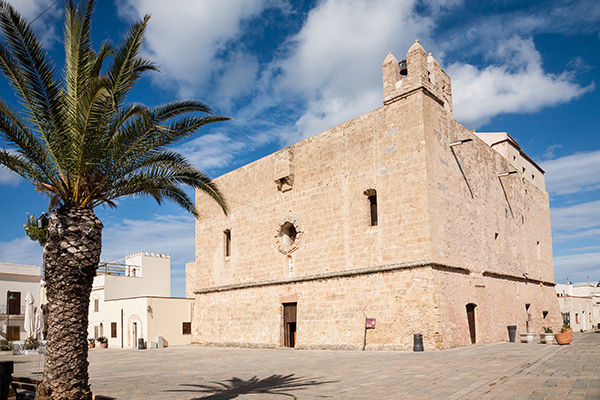
San Vito Lo Capo is a place with a clear tourist vocation, a welcoming destination where you can forget your worries. A relaxing spot that also offers the chance to enjoy countless cultural and natural attractions.
From relaxing on the beach to boat trips, from trekking in natural reserves to visits to nearby archaeological sites, as well as diving in the magnificent seabeds and exploring its monuments.
And of course, how could one forget the scents of its cuisine and the colourful alleyways adorned with bougainvillea?
San Vito Lo Capo is a place to arrive and linger, but also an excellent starting point for discovering the most important tourist destinations in the provinces of Trapani, Palermo, and Agrigento!
The name of San Vito has been linked to this territory since the 5th century, the period in which the young Vito is believed to have been martyred. Christians from western Sicily visited this place through continuous pilgrimages by land and sea, keeping the memory of the martyr alive with a small Sanctuary.
The Sanctuary began to be fortified after the fall of Constantinople to the Turks (in the mid-15th century), in order to defend it from frequent acts of piracy and to ensure the safety of the pilgrims. Today it stands as an imposing religious-military structure overlooking the beautiful square.
Piazza Santuario is the nerve centre of San Vito Lo Capo, from which the main artery, Via Savoia, and countless charming little alleys branch out.
Strolling through the centre of San Vito Lo Capo is always a pleasure: stopping for a good ice cream, buying typical or handcrafted products, or enjoying yourself in one of the many small boutiques.
Throughout the year, numerous events animate the square, the seafront, Palazzo La Porta — home to the town hall — and Piazza Marinella, another lively meeting place for both tourists and residents.
The sanctuary, the square
and the historic center
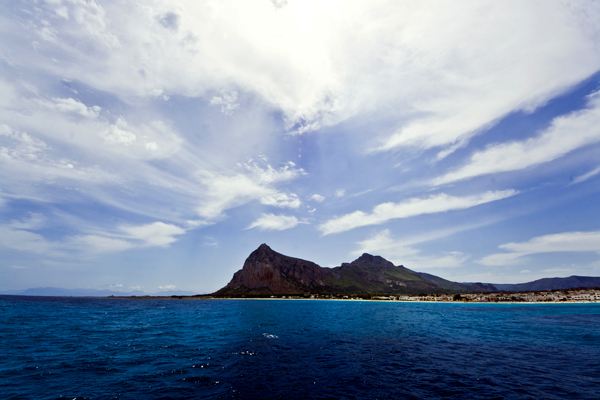
The Tonnara del Secco
In the tuna fisheries, the social and economic life of many Sicilian coastal towns — including San Vito Lo Capo — was built. The Tonnara del Secco dates back to the 4th century BC and was initially used by the Carthaginians.
It has been out of use since 1969, but even today, next to the buildings of the tonnara, you can admire the remains of ancient fish processing facilities, which also date back to the 4th century BC.
We recommend a sunset bike ride or a swim in the crystal-clear blue waters.
The Watchtowers
and the Torrazzo
The towers, dating back to the 16th century, were built for military purposes — to spot and signal dangers coming from the sea.
Between Monte Cofano and San Vito Lo Capo, and on the other side as far as the Zingaro Reserve, several towers stand; some still preserve their ancient structure intact: Torre Isulidda, Torre dell’Uzzo — near the cave of the same name — followed by Torre di l’Impisu (or ’mpisu, “the hanged man’s tower”) and Torre Du ‘Sceri. All the towers share the same square-based structure, with few internal divisions and a large cistern for collecting rainwater.
The “Torre Vecchia”, commonly known as the Torrazzo, was built at the end of the 14th century, also intended for the defense of the land. Unlike the others, however, it features a cylindrical shape and stands slightly set back from the beach, behind the port of San Vito Lo Capo.
The Cliffs
and the Prehistoric Caves
San Vito Lo Capo is surrounded by extraordinary orange-red cliffs of rare beauty, which over the years have fascinated climbers from all over the world.
El Bahira, Torre del Tuono, Roccia delle Favole, Salinella — just to name a few — stand before the viewer as unique and spectacular rock formations.
Along the coastal cliffs, one can admire several karst caves, evidence of human presence in this territory as far back as the 10th millennium BC. The remains of hypogeal burials, discovered between the town and the tonnara, suggest that a permanent settlement may have continued in later periods as well.
Today, lovers of outdoor activities and nature can enjoy the coastal trails stretching along the shoreline near San Vito Lo Capo, and admire the majestic Grotta dell’Uzzo and Grotta del Cavallo, currently more accessible than the others.
The Castelluzzo area is known as “The Valley of the Olive Trees” due to the extensive olive plantations surrounding the town, making it a must-visit destination for nature tourism and for lovers of hiking and horseback riding.
Downhill from Castelluzzo, with the Monte Cofano Nature Reserve on one side and the Santa Crescenza plateau on the other, lies the majestic Cofano Bay and Castelluzzo, featuring Cala dell’Arena beach (today Baia Santa Margherita) and numerous small coves with white pebbles stretching all the way to the “Fishermen’s Village” at the foot of Monte Cofano.
In the area, not to be missed are Isulidda, Calazza, Bue Marino, and several small gravel coves, each more enchanting than the last.
Cofano Bay
and Castelluzzo
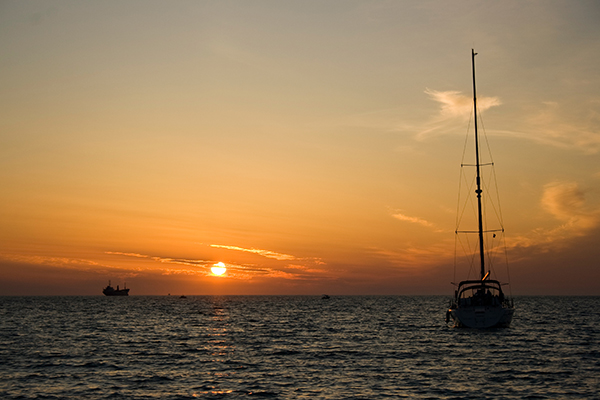
The Zingaro Nature Reserve
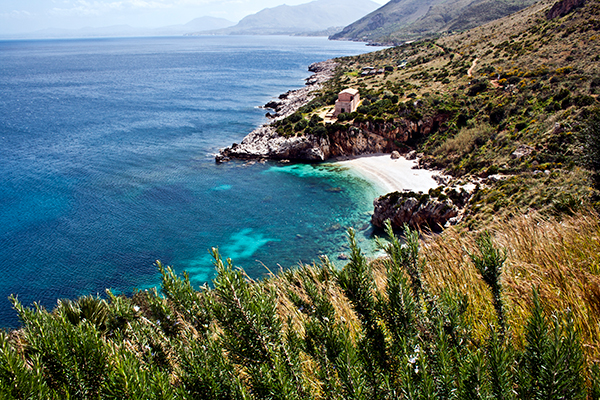
The Zingaro coastline is one of the few stretches of Sicilian coast untouched by a coastal road. The Zingaro Nature Reserve has two access points, one from San Vito Lo Capo and one from Scopello.
In 1976, a human chain blocked the start of construction of a major road, giving rise a few years later to the first Nature Reserve in Sicily.
Today, trails winding through the Mediterranean scrub alternate with paths that lead to stunning pebble coves. It is an enchanting place where you can also discover the customs and traditions of the shepherds and artisans who once inhabited the area.
Trapani
The city of Trapani stands on a narrow, crescent-shaped peninsula, washed by two seas.
Legend has it that Trapani was the backdrop for the deeds of the goddess of harvest, Ceres, who was said to have been abandoned here while searching for her daughter Proserpina.
Originally a Sicani village (called Drépanon by the Greeks), it later became a place of major dominations due to its strategic position: Romans, Arabs, Normans, Aragonese, and Bourbons all left their mark.
Today, Trapani boasts a precious historic center, where visitors can discover courtyards, historic palaces, churches, and splendid seaside promenades overlooked by beautiful domes.
The Saline of Trapani
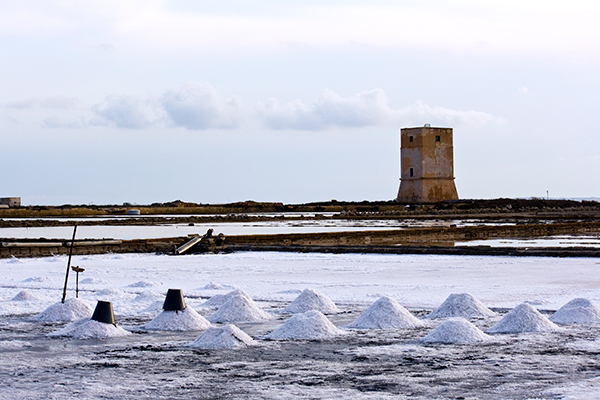
Strokes of pink and mounds of shining white. The saline of Trapani, along the coastal road from Trapani to Marsala, can be summed up in these two colors.
But there are also the windmills, the salt workers’ paths, the enchanting pink flamingos, and breathtaking sunsets — sights you have to see to believe.
Segesta
A place where time has stood still.
At Segesta, you can still admire the Doric Temple dating back to the 5th century BC and the theater partially carved into the rock (2nd century BC), both from the era of the ancient city founded by the Elymians and destroyed in 306 BC by the Carthaginians.
Make sure to set aside time for this unmissable excursion.
Erice
Erice is a beautiful medieval village that still preserves its ancient layout, cobbled streets, and stone houses. Countless churches, charming flower-filled courtyards, the splendid castle, and breathtaking panoramic views make Erice an unmissable stop in the region.
The Cordici Museum houses an important archaeological find discovered in a local necropolis: a Head of Aphrodite dating back to the 4th century BC. Of notable architectural interest are the Mother Church, dating back to the year 300, and the Venus Castle (12th–13th century).
Stroll through the alleys decorated with ceramics and carpets, indulge in the aroma of traditional sweets like the Genovesi, and be enchanted by the delicacy of almond pastries.
Palermo and Agrigento
Palermo is just over an hour from San Vito Lo Capo, but it is a must-visit for those who want to immerse themselves in a past full of wealth, dominations, Baroque art, and culture.
Palermo is truly extraordinary with its Cathedral, the Palatine Chapel, the domes, and its squares.
The road to Agrigento is a bit longer, but once you arrive at the Valley of the Temples, you will find yourself in a park of about 1,300 hectares, one of the largest archaeological complexes in the Mediterranean.
It preserves an extraordinary monumental and scenic heritage, including the remains of the ancient city of Akragas and the surrounding territory stretching to the sea.
